


In manufacturing, efficiency is not just a goal; it is essential for maintaining competitiveness and profitability. Facilities continuously seek ways to reduce costs, improve productivity, and maximize available resource utilization. However, identifying opportunities for improvement can be challenging without the right data, analytics, and performance measurement tools. This is where Overall Equipment Effectiveness (OEE) becomes invaluable. By providing insights on how effectively equipment is operating, OEE helps manufacturers uncover inefficiencies and drive measurable gains in performance.
OEE stands for overall equipment effectiveness and is used when measuring manufacturing productivity to identify how much of the time is productive. From a packaging perspective this can be a useful tool to identify bottlenecks and unnecessary stoppages in the line. If you would have 100% OEE this would mean there would be no downtime (the availability), at full speed operation (the performance), with zero defects (the quality). Measuring the OEE can be an effective tool to improve your manufacturing process and understand better where losses are coming from.
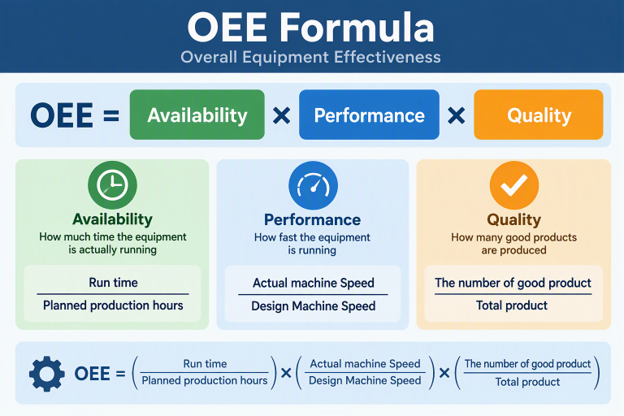
When planning for a new packaging line, an important first step is to think about your planned and unplanned down time during production time, or your Availability factor. In this factor, unplanned downtime could mean changing out consumables (i.e. shrink wrap, fiber change out, or label changes), no maintenance calls, shift changes, or downtime due to equipment breakdowns. Accounting for these downtimes can give an effective idea of required and unplanned down times. A score of 100% availability would mean the packaging line would always be running during planned production times with no stoppages. To find your production factor, take the production time and divide it by the planned production time. Scheduled downtime, such as change overs or planned shut downs, would not be part of this calculation. The resulting number would be your loss of machinery availability due to all production downtime.
As the future packaging line is evaluated another piece of the equation to take into account is the line Performance factor. Evaluating the line performance would mean taking into account the slow cycles and the small stops in the line during planned production time and dividing this number by the theoretical production time. The theoretical production time would be the maximum output or throughput of the equipment. To have a score of 100% performance, the line would need to be running at full speed. The resulting number that would have been calculated is your loss of production time.
The last factor to take into account is the quality of the line. When thinking of the quality, evaluate and account for production parts with defects or requiring rework in the line. Finding the Quality factor would mean taking the Actual production time and divide this number by the theoretical time to produce. When calculating this number, remove the stoppages and defects from the actual production time. To reach a score of 100% quality, there would be no defects or rework required throughout the whole planned production time.
After finding the Availability, performance and quality factors, multiply all together to find the percentage, which would be your Overall Equipment Effectiveness. The goal for many companies is to have 60% OEE, as this is seen by many as having good efficiency. A score of 85% OEE has been nationally recognized by discrete manufacturers as “World Class Manufacturing Excellence.”
Having low OEE could be an indicator of many things, below is a list of possible OEE improvement strategies. In the short term, evaluating OEE can effectively show the total opportunity for improvement. In the long term, evaluating OEE can drive and engage improvement through measurable understanding of losses.
- Possible OEE Improvements
- Improve preventative maintenance program
- Improve spare parts on hand
- Update end of life equipment
- Improve shift change strategies
- Improve Training plans
- Automate and improve line adjustments or measurements for preventing defects
To help maximize OEE and find improvement opportunities, simulation technologies and models can be used to evaluate packaging line performance in a virtual environment before costly physical changes are implemented. Discrete event simulation models allow manufacturers to assess the impact of variables such as new equipment, layout and conveyor modifications, buffer sizing, and production schedules on throughput and equipment utilization. By serving as both a predictive and validation tool, simulation enables project teams to analyze expected performance improvements, reduce implementation risk, and make data-driven capital investment decisions before detailed engineering begins. When used alongside OEE methodologies, simulation provides valuable insight into availability, performance, and quality losses, helping manufacturers prioritize projects that will deliver the greatest operational benefits.
Matrix Technologies is one of the largest independent process design, industrial automation, engineering, and manufacturing operations management companies in North America. To learn more about our packaging engineering and discrete manufacturing capabilities, Brandon Grodi, PE, Senior Manager in the Mechanical & Facilities Design Department.


